Draft
Minutes
ASC OP/TF 4, Conversion of ISO 10110 to a National Standard Task Force Meeting
October 20, 2008
Rochester Plaza Hotel and Conference Center, River Room
70 State Street, Rochester, New York 14614
Present
10 Attendees; 1 Alternate Representing 20 ASC OP Member Organizations
Committee Members
Representing
David Aikens
Savvy Optics Corporation
Gordon Boultbee (Alternate)
JDSU Corporation
Andrei Brunfeld
Xyrtex
Benjamin Catching (by phone)
JDSU Corporation
David Corridon
Individual
Walter Czajkowski
APOMA (Edmund Optics)
Frank Dombrowski
Gage-Line Technology, Inc.
Marla Dowell
IEEE/LEOS
Marla Dowell
NIST
Lincoln Endelman
SPIE, (Endelman Enterprises)
Charles Gaugh
Davidson Optronics, Inc.
Krishna Gupta
Zygo Corporation
John Hamilton
Northrop Grumman
Hal Johnson
Harold Johnson Optical Lab
Alan Krisiloff
Triptar Lens Co., Inc.
Jonathan McGuire (Alternate)
Northrop Grumman Laser Systems
Wayne McKinney
Lawrence Berkley National Lab
Bruce Netherton
Lockheed Martin Coherent Technologies
Sam Richman (Alternate)
Research Electro-Optics, Inc.
William Royall
Retired
Peter Takacs
Brookhaven
Trey Turner
Research Electro-Optics, Inc.
Steve VanKerkhove
Corning Tropel
Ray Williamson
Ray Williamson Consulting
Observers (5)
Jessica DeGroote
Optimax Systems, Inc.
Gene Kohlenberg
OEOSC
Stephen Martinek
4D Technology Corporation
Rick Plympton
Optimax Systems, Inc.
Alan Tourtlotte
OSA
Auditor's Summary of Meeting
OP has decided to adopt ISO 10110 as an ANS. Individual Members of the Task Force made presentations concerning
ISO 10110 -1, 2, 3, 4, 5, 6, 10, and 12. Parts 1 and 10 require some modification for US interests, and a draft forewords
were edited. The other sections were presented so that the members of the Task Force could decide what modifications are
necessary before adopting them as ANS. Assignments were made for action items to be completed before the next meeting
in January 2009.
Welcome and Introductions
D. Aikens opened the meeting at 8:37 a.m. He asked those attending to introduce themselves.
Adoption of Agenda
A. Krisiloff moved that the agenda be approved, and M. Dowell seconded it. The motion carried unanimously.
Approval of the Minutes of the August 22, 2008 Teleconference
P. Takacs moved that the minutes be approved, and W. Royall seconded the motion, which carried unanimously.
01/06/09 02:07:01 PM
1 of 5
File: TF 4 Draft Minutes ISO 10110 10-20-08.odt
Check Box

ASC OP/TF 4, Conversion of ISO 10110 to a National Standard Task Force Meeting, 10/20/2008, Continued
Review of Work Since the Last Meeting
D. Aikens reviewed the progress during the previous meeting. The question was what number could be assigned to the
US version of the ISO 10110 documents. Following the October meeting the Secretary had purchased the "Regional or
national adoption of International Standards and other International Deliverables -- Part 1: Adoption of International
Standards," and determined that the US version of the ISO 10110 documents would have to be considered a "modification"
type because the "vice versa" principle was violated. D. Aikens had hoped that the documents could be numbered
ANSI/ISO 10110-... However, the document must have a unique US number, such as "ANSI/OEOSC 1.110-... (ISO
10110-...MOD)."
A. Krisiloff asked if the suggested foreword discussed at the August meeting is acceptable. The Secretary said that if
that foreword is used, then the document is considered a modification to the original ISO document and, therefore, must
have a unique US number assigned to it. A. Krisiloff continued by asking what the title would be. The secretary said that
part 1 would be "American National Standard for Optics and Electro-Optical Instruments Preparation of drawings for
optical elements and systems Part 1: General."
D. Aikens said that the 1.110 looks similar to the 10110; however, could OP change the number to 10.110. The
Secretary asked why he would want to bastardize the existing OP numbering system to fake the number. He continued that
when someone searches for the ISO 10110 on a database, both the ISO version and the US version would appear because
ISO 10110 is part of the title. D. Aikens said that when the ISO version is discussed, it is referred to as "ten one ten" and if
we made our number 10.110, it could also be called "ten one ten." The Secretary said that the first "1" signifies that the US
standard is a fundamental standard, corresponding to a standard released by ISO/TC 172/SC 1. D. Aikens asked if the OP
numbering system could be changed. The Secretary said that if he wants to change the system, then OP is going to have to
decided the new rules. D. Aikens started down the list of SCs to see what is represented. The Secretary said that the
TAG/SC 9 is unhappy with one of the standards that ISO approved despite its protests. A member of the TAG/SC 9 asked
what recourse they would have. The Secretary told him that the TAG/SC 9 could adopt a modified version of the standard
under the OP banner. That standard would have an ANSI/OEOSC OP9.xxx (ISO XXXXX MOD) number assigned to it.
A. Krisiloff said that the Task Force should not propose a decision now. D. Aikens agreed and added that the
numbering may not be important. The worry about the US numbering could be a tempest in a teapot in that the standard
could be adopted or ignored either way, or it could be the defining silly little thing that caused the standard to get lost. The
Secretary said that the document should not get lost because "ISO 10110" is always a part of the title. D. Aikens said that
however, in Germany the parenthetical phrase is forgotten. The Secretary countered that Germany has no parenthetical
phrase because they adopted the standard verbatim. R. Williamson pointed out that "10.110" will not show up in a search
for "10110."
A. Krisiloff said that a reason for wanting the ISO name is that US companies may begin to want to participate on an
international level so that ten years down the road the American influence in the standards will eliminate the need to create a
US variation to a standard. The need to create an American version from scratch all of the time becomes a hellishly
complicated process.
D. Aikens noted that some of the ISO 10110 parts will not be MODs, but it would be preferable if they were all
numbered the same way. M. Dowell said that even the documents that can be taken verbatim will need modifications to the
forewords because the documents make reference to each other. D. Aikens said that not all of the parts reference the other
parts. He ended the discussion at this point.
Proposed rewording of the wavelength note in the foreword
D. Aikens described the lengthy discussion concerning whether the international wavelength or a US preferred
wavelength should be used. G. Boultbee and A. Krisiloff both offered edits to the wording of the US Foreword of ISO
10110-1. G. Boultbee read his revised edits to the foreword. "Since the default wavelength in the United States is the red
HeNe line, 632.8 nm, this wavelength is presumed when no specific wavelength is given, rather than that given in
ISO 7944. ISO 7944 should be considered an informative reference rather than normative. However, to avoid
misinterpretations the wavelength should always be stated on drawings."
D. Aikens asked if there were any other changes to the document. The Secretary said that notes could be added within
the document at the points of change since the US version is a modification of the ISO version. G. Boultbee wondered if
the ISO original foreword would confuse users if it were left in the document. A. Krisiloff noted that what OP does should
make the standard more usable, not more confusing. Some thought the document should be given to further editing.
D. Aikens agreed that if the US foreword says that something is informative, and the text then says that it is normative, there
could be confusion. Notes could be added to clarifying the US changes within the document.
G. Boultbee stated that one area where a note would be advantageous is "Section 3 Fundamental stipulations", where
01/06/09 02:07:01 PM
2 of 5
File: TF 4 Draft Minutes ISO 10110 10-20-08.odt

ASC OP/TF 4, Conversion of ISO 10110 to a National Standard Task Force Meeting, 10/20/2008, Continued
the reference wavelength is specified.
R. Plympton said that 650 nm diodes are now being used to evaluate surfaces, so tagging 632.8 nm may not be prudent.
S. Martinek said that his company uses an equivalent wavelength, so the actual wavelength can be anything. M. Dowell
noted that the current ISO standard does not prohibit the user from specifying a wavelength.
A. Krisiloff said that defaults are important on a standard.
D. Aikens concluded that the discussion resulted in an agreement that the Task Force should not force the US industry
to change its default. R. Plympton said that he would prefer 632.8 nm rather than 546.1 nm.
"Section 4.7b Material properties" makes reference to other sections of the ISO 10110 series.
D. Aikens will prepare an update to ISO 10110-1 to add notes to the body of the document.
Foreword to US version of ISO 10110-10
D. Aikens said that feedback from the training class is that users would like to be able to put the symbol for texture in a
table at the bottom of the sheet. ISO requires that the symbol be associated with the surface. Note 1 in the draft ANS
Foreword addresses that request. This change also helps the software designers who will not have to be able to float the
symbol near an object in the drawing.
R. Plympton asked if the fine ground surfaces could be handled similarly.
Note 2 will make the ISO 10110-11 informative, until A. Krisiloff completes an ANS version.
Note 4 is intended to fix a flaw in the ISO version. In use all information is included on the drawing. The software
packages are not compliant with the ISO method. In practice all information is included in a drawing for a doublet.
P. Takacs asked about cube beam splitters in this instance. D. Aikens said that beam splitters are not tabulated , just as
a drawing. B. Catching said he always saw it treated as in Part 5. D. Aikens said that he could ask someone at ASML to
about prisms.
In note 5 D. Aikens identified a problem with a table of an assembly using a buried surface, which is both convex and
concave. R. Williamson said that the orientation of the surface could be defined relative to the center of curvature.
Notes 6 and 7 should be identical to those in Part 1.
Note 8 should be made identical to what was done in Part 1 (G.K.)
.
D. Aikens said that all of the changes proposed here should be adopted by ISO.
Review of ISO 10110-2, 3, 4
A. Krisiloff presented a table comparing OP3.001:2001, 10110-2:1996, 10110-3:1996, 10110-4:1997, 10110-4:2002
proposed, 12123:2008. Glass manufacturers do not like ISO 10110-3, and have made changes in proposed
ISO 12123:2008. A. Krisiloff questions whether the ISO 10110 parts should be considered. W. Royall asked if a customer
buys glass using ISO specs, will the manufacturer be able to comply. A. Krisiloff said that they would have to make some
kind of conversion factor. M. Dowell suggested that a conversion chart could be added to the US standard. D. Aikens said
that he has had success specifying glass by Part 3.
OP3.001:2001(0223)
10110-2:1996(0315)
10110-3:1996(????)
10110-4:1997(0801)
10110-4:2002(0508)
Proposal to replace
parts 2, 3, and 4 (H.
Pollicove)
12123:2008(DIS)
Stress
Birefringence
Defined
No notation prescribed
No classes defined
Specify max nm/cm
Indicate: 0/ x nm/cm
Default: 0/ 20
Just some typical apps
and their requirements
listed in Annex A
- - - - - -
- - - - - -
No classes defined
Specify max nm/cm
Indication: 0/x nm/cm
Default: NONE
2 nm/cm
4 nm/cm
6 nm/cm
12 nm/cm
<20 nm/cm
20 nm/cm
Bubbles
And
Inclusions
Total area of
diam>0.05mm
IG4 [0.00, 0.03]
IG3 (0.03, 0.10]
IG2 (0.10, 0.25]
IG1 (0.25, 0.50]
IG0 (0.50, 0.99]
Indicate:
Default: NONE
- - - - - -
No Classes Defined
Specify directly
Accumulation applies
Suggested sqr(area)
Indication: 1/ N x A
Default: 1/ 3 x 0.16,
etc.
- - - - - -
Total area of diam >
0.05mm
IG4 [0.00, 0.03]
IG3 (0.03, 0.10]
IG2 (0.10, 0.25]
IG1 (0.25, 0.50]
IG0 (0.50, 0.99]
Indication: 1/IGx
Default: NONE
Max number of specified
sized bubbles
10 x 0.03 mm2/100 cm3
30 x 0.10
70 x 0.25
140 x 0.50
Inhomogeneity
HG5 ± 0.5 ppM
HG4 ± 1.0 ppM
HG3 ± 2.0 ppM
HG2 ± 5.0 ppM
HG1 ±20.0 ppM
- - - - - -
- - - - - -
5 ± 0.5 ppM
4 ± 1.0 ppM
3 ± 2.0 ppM
2 ± 5.0 ppM
1 ±20.0 ppM
0 ±50.0 ppM
HG5 ± 0.5 ppM
HG4 ± 1.0 ppM
HG3 ± 2.0 ppM
HG2 ± 5.0 ppM
HG1 ±20.0 ppM
± 0.5 ppM
± 1.0 ppM
± 2.0 ppM
± 5.0 ppM
±20.0 ppM
±50.0 ppM
01/06/09 02:07:01 PM
3 of 5
File: TF 4 Draft Minutes ISO 10110 10-20-08.odt
ASC OP/TF 4, Conversion of ISO 10110 to a National Standard Task Force Meeting, 10/20/2008, Continued
OP3.001:2001(0223)
10110-2:1996(0315)
10110-3:1996(????)
10110-4:1997(0801)
10110-4:2002(0508)
Proposal to replace
parts 2, 3, and 4 (H.
Pollicove)
12123:2008(DIS)
Indicate:
Default: NONE
Indication: 2/x; -
Default: 2/ 1; 1
Indication: 2/HGx; -
Default: NONE
Striae
A No visible Striae
B Light difficult few
C Light easy to see
scattered
D Pervasive
Indicate:
Default: NONE
- - - - - -
- - - - - -
Areal fraction
5 extremely clear
4 1% 30nm/cm
3 2%
2 5%
1 10%
Indication: 2/ - ; x
Default: 2/ 1;1
A No visible Striae
B Light difficult few
C Light easy to see
scattered
D Pervasive
Indication: 2/ - ;x
Default: NONE
< 2 nm/cm
< 3 nm/cm
< 6 nm/cm
<12 nm/cm
Abbe
Value
AVG3 ±0.2%
AVG2 ±0.3%
AVG1 ±0.5%
AVG0 ±0.8%
Indicate:
Default: NONE
- - - - - -
- - - - - -
- - - - - -
AVG3 ±0.2%
AVG2 ±0.3%
AVG1 ±0.5%
AVG0 ±0.8%
Indication: abbe AVGx
Default: AVG0
± 0.2%
± 0.3%
± 0.5%
± 0.8%
Refractive
Index
RIG3 ±0.0002
RIG2 ±0.0003
RIG1 ±0.0005
RIG0 ±0.0010
Indicate:
Default: NONE
- - - - - -
- - - - - -
- - - - - -
RIG3 ±0.000 2
RIG2 ±0.000 3
RIG1 ±0.000 5
RIG0 ±0.0010
Indicate: index RIGx
Default: NONE
± 0.000 2
± 0.000 3
± 0.000 5
± 0.001 0
± 0.002 0
G. Boultbee said that ISO 12123:2008 has a dissertation about why one cannot buy glass to final part specifications.
Draft ISO 12123:2008 uses the same divisions but does not use the grade identifiers.
A. Krisiloff said that there is no default in ISO 12123:2008.
ISO 12123 says to forget striae appearance and grade and use homogeneity measurements. D. Aikens said that Schott
had published a document describing their technique. All glass manufacturers now use this technique.
A. Krisiloff asked what would be changed to make Parts 2, 3, and 4 acceptable in the US. D. Aikens said that in his
class he suggests that users apply Parts 2 and 3 and if they use Part 4 they should make a note saying that striae is measured
per OP3.001. M. Dowell asked if OP3.001 would be preferred or would ISO 12123:2008. ISO 12123 is not yet released.
W. McKinney suggested that the method in ISO 12123 is a good way to do it.
A. Krisiloff has agreed to making changes for ISO documents. M. Dowell asked if ISO 12123 is an acceptable
alternative. D. Aikens said that the user community wants grades. He proposed that OP3.001 be modified to use the values
in ISO 12123 then offer it to the international community.
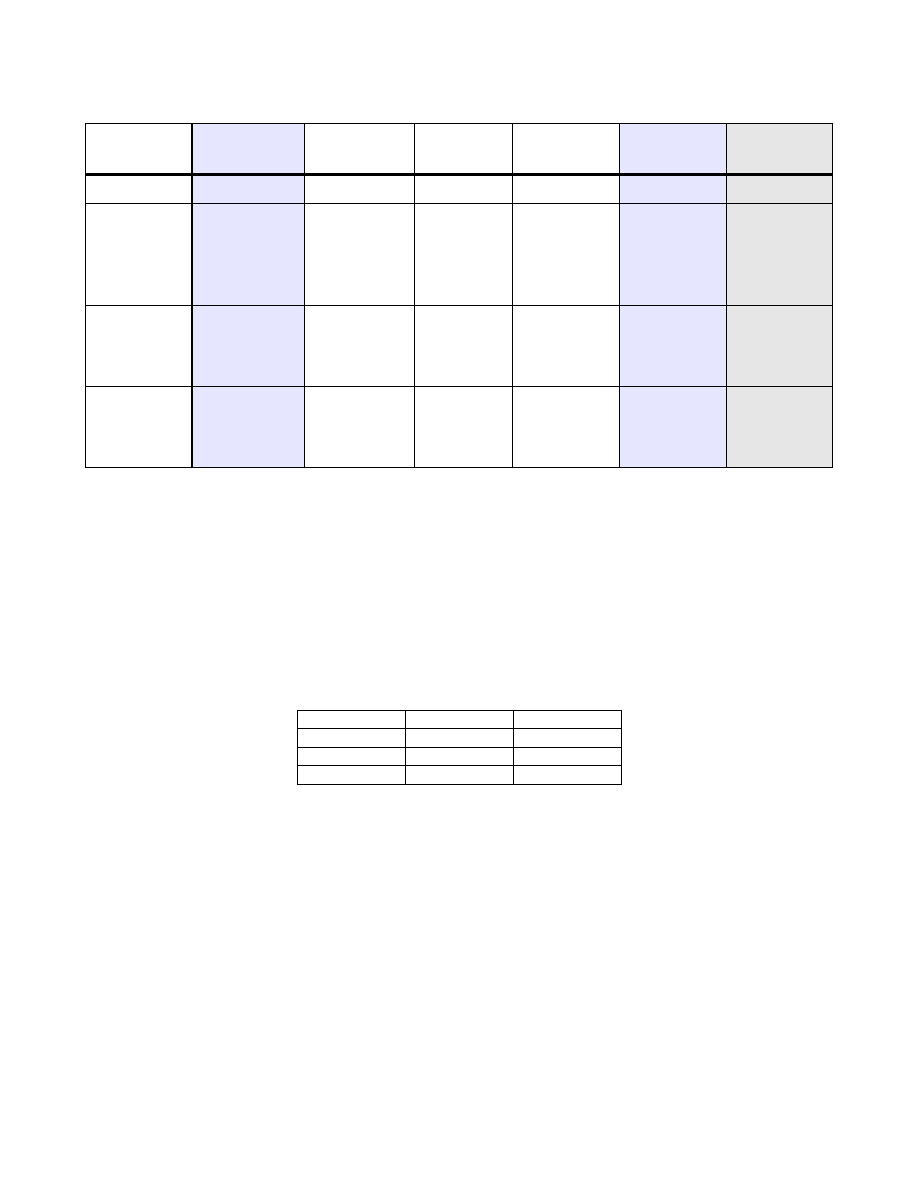
D. Aikens suggested that there are three choices for the American version.
OP3.001
ISO 10110-2, -3, -4
ISO 12123
X
X
X
He recommendation to modify grade specifications in OP3.001 to be consistent with ISO 12123 and then also offer it to
ISO. He continued that the ISO version could not have measurement information in it.
The Task Force agreed to use line 2 in the above table.
At this point the meeting was recessed at 10:40 a.m. and reconvened at 10:50 a.m.
Review of ISO 10110-5
B. Catching said that we would need to adopt ISO 14999-4:2004 when adopting ISO 10110-5. He has a copy of
ISO 14999-4 on order. ISO 10110-5 could be adopted as is even though the US optics industry is not used to it. D. Aikens
suggested that the default wavelength should be changed to 632.8 nm. B. Catching said that the user could be required to
specify the wavelength. MetroPro software allows the user to convert the wavelength. It does not have provision for total
peak-to-valley.
J. DeGroote said that they now use peak-to-valley, but want to convert to RMS. R. Plympton said that the opticians
like to see peak-to-valley for figuring the surface.
D. Aikens asked if B. Catching would review ISO 14999-4 for possible adoption as an ANS and then suggest a
foreword for ISO 10110-5.
01/06/09 02:07:01 PM
4 of 5
File: TF 4 Draft Minutes ISO 10110 10-20-08.odt

ASC OP/TF 4, Conversion of ISO 10110 to a National Standard Task Force Meeting, 10/20/2008, Continued
Review of ISO 10110-6
R. Williamson presented a slide review of Part 6 (the file is available on optstd.org). He suggested that the ANS
version could be a substantial rewrite of the ISO version.
D. Aikens proposed that the US accept the Chinese proposal for section 3.5, but R. Williamson should make a
recommendation to the Task Force.
In Figure 3 the Chinese want to delete view b, but D. Aikens says that the Germans love it.
R. Plympton said that Optimax measures edge thickness difference: ETD.
D. Aikens said that Part 6 needs to be rewritten at the international level, and OP must decide whether to accept the
current version, or modify it and release it as an ANS while it is moving through ISO.
D. Aikens proposed that Part 6 be referenced by the ANS version of ISO standard.
Review of ISO 10110-8
Not done. Will write up proposal.
Review of ISO 10110-9
Not done. Will write up proposal.
Review of ISO 10110-11
Not done. Will write up proposal.
Review of ISO 10110-12
B. Catching also reviewed this part. It is recent and very thorough. There are not a lot of defaults, but there are
options. It does not give priority to those options if there is a conflict.
P. Takacs asked if the equations for the local slope deviation are given. D. Aikens said that the equations are not given.
B. Catching said that the standard provides the slope tolerance in either axis for an asymmetric asphere in angular or
whatever units the user wants. Integration length and resolution are also specified. P. Takacs said that Part 5 defines
deviations perpendicular to the axis. D. Aikens said that the author recognizes the problem and will address it.
D. Aikens asked if B Catching would write a foreword to recognize the deficiencies.
D. Aikens said that Greg Forbes has a new equation for aspheres that is more robust. It should be on the to-do list for
the next version of the standard.
D. Aikens will send B. Catching the e-mails from Greg Forbes.
Action items
D. Aikens will provide the action items.
B. Netherton moved that D. Aikens prepare drafts of Parts 1 and 10 by November 30, 2008 for review by the Task
Force by December 31, 2008. A. Tourtlotte seconded the motion. The motion carried unanimously.
Time and Place of next TF 4 Meeting
The Task Force agreed to meet during Photonics West in San Jose, CA on Monday, January 26, 2009, 8:30 a.m.
12 noon. Following meetings may be held at Optifab in Rochester, NY on Tuesday, May 12, 2009, or possibly
Monday,October 12, 2009 in San Jose, CA.
Adjourn
M. Dowell moved that the meeting be adjourned; R. Williamson seconded the motion, which carried unanimously. The
meeting adjourned at 12:23 p.m.
01/06/09 02:07:01 PM
5 of 5
File: TF 4 Draft Minutes ISO 10110 10-20-08.odt