Template for comments and project leader observations
Date: 7 May 2009
Document: Commentary on Comments received
about proposed changes for OP1.002
1
2
(3)
4
5
(6)
(7)
IN
1
Clause No./
Subclause No./
Annex
(e.g., 3.1)
Paragraph/
Figure/Table/
Note
(e.g., Table 1)
Type
of
comm
ent
2
Comment (justification of change) by the project participant
Proposed change by the project participant
Project leader
observations
on each comment
submitted
1
IN: Initials of the project participant
Page 1 of 4
2
Type of comment: ge = general
te = technical
ed = editorial
NOTE
Columns 1, 2, 4 and 5 are mandatory
OEOSC document comments template version 1.0
GB
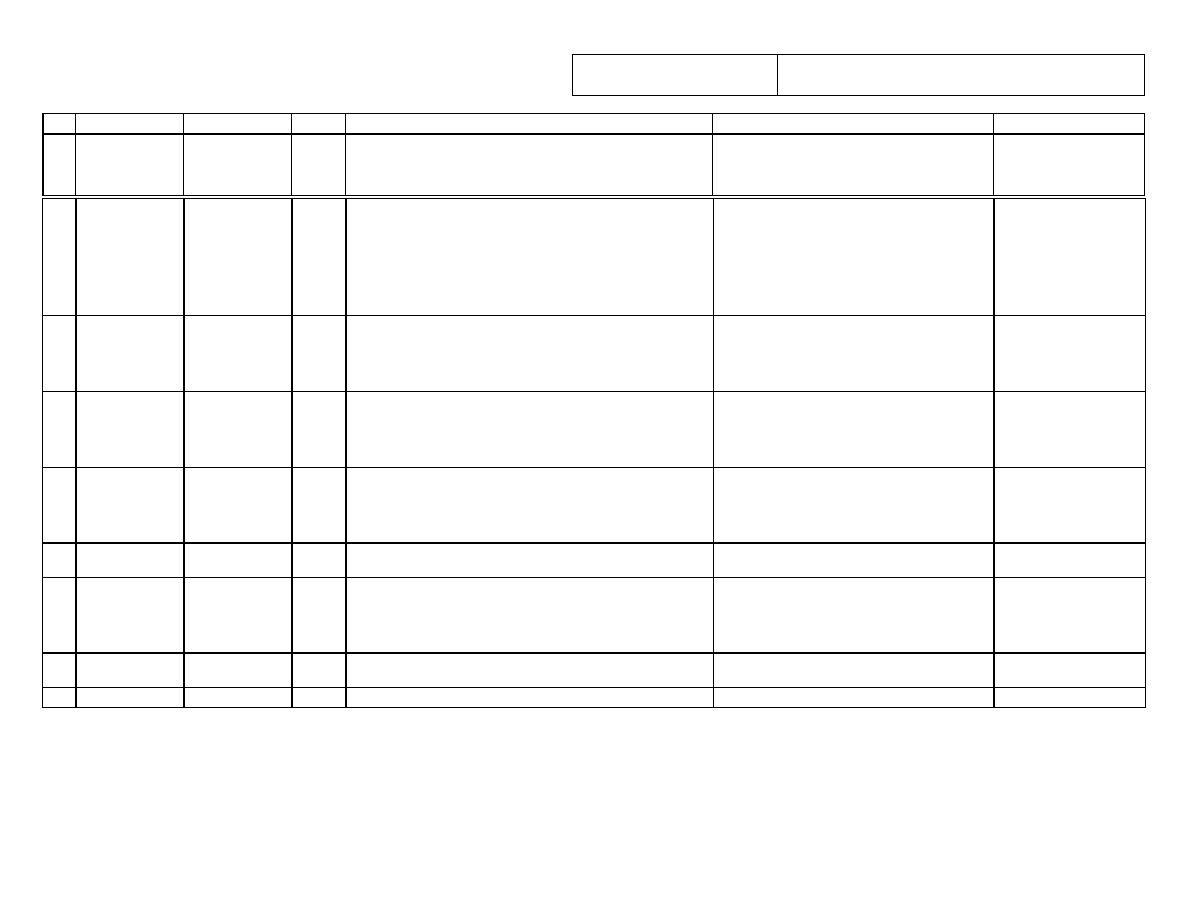
3.5.3
te
Simplify the wording to more closely match the existing wording in
MIL-C-48497A.
The scratch letter defines the largest width of the
scratch in accordance with Table 1.
I thought we are trying to
disconnect the use of
letters to designate a
specific width. I thought
we want to emphasize
that letters represent
ranges with an upper
and lower boundary.
GB
3.5.3
Table 1
te
Binning scratches into classes is appropriate, and is the only
practical way to evaluate them visually without magnification.
However, when/if they are being evaluated with magnification I
think we need the option to allow the actual measured largest
width of each scratch to be used in the calculations.
YES
GB
3.5.3
Table 1, col. 3
te
This is a serious step backward from the prior version with
"disregard" numbers in microns. It is confusing and not what
people who perform inspections want to know.
Change column 3 back to "disregard" numbers in
microns.
The old language
requires twisted
explanations about how
"disregard" doesn't
always mean ignore.
DA
3.5.3
te
How are you going to determine the widest portion of the scratch
if you are viewing it without magnification?
Is the entire concept of
the dimensional
specification
meaningless for visual
inspection?
DA
3.5.3
Table 1, col. 3,
row 3
te
Error in accumulation
Change "Classes A2 and A" to "A2.5 and A."
YES
GB
3.5.4
Table 2, col. 3
te
This is a serious step backward from the prior version with
"disregard" numbers in millimeters. It is confusing and not what
people who perform inspections want to know.
Change column 3 back to "disregard" numbers in
millimeters.
The old language
requires twisted
explanations about how
"disregard" doesn't
always mean ignore.
GB
3.5.3, 3.5.4
Tables 1, 2
ed
Format
Center the information in the columns, use µm
instead of um.
YES
FD
3.5.5.1
te
Based on the information given the designation is wrong
Change "D-D" to "E-D."
YES
Template for comments and project leader observations
Date: 7 May 2009
Document: Commentary on Comments received
about proposed changes for OP1.002
1
2
(3)
4
5
(6)
(7)
IN
1
Clause No./
Subclause No./
Annex
(e.g., 3.1)
Paragraph/
Figure/Table/
Note
(e.g., Table 1)
Type
of
comm
ent
2
Comment (justification of change) by the project participant
Proposed change by the project participant
Project leader
observations
on each comment
submitted
1
IN: Initials of the project participant
Page 2 of 4
2
Type of comment: ge = general
te = technical
ed = editorial
NOTE
Columns 1, 2, 4 and 5 are mandatory
OEOSC document comments template version 1.0
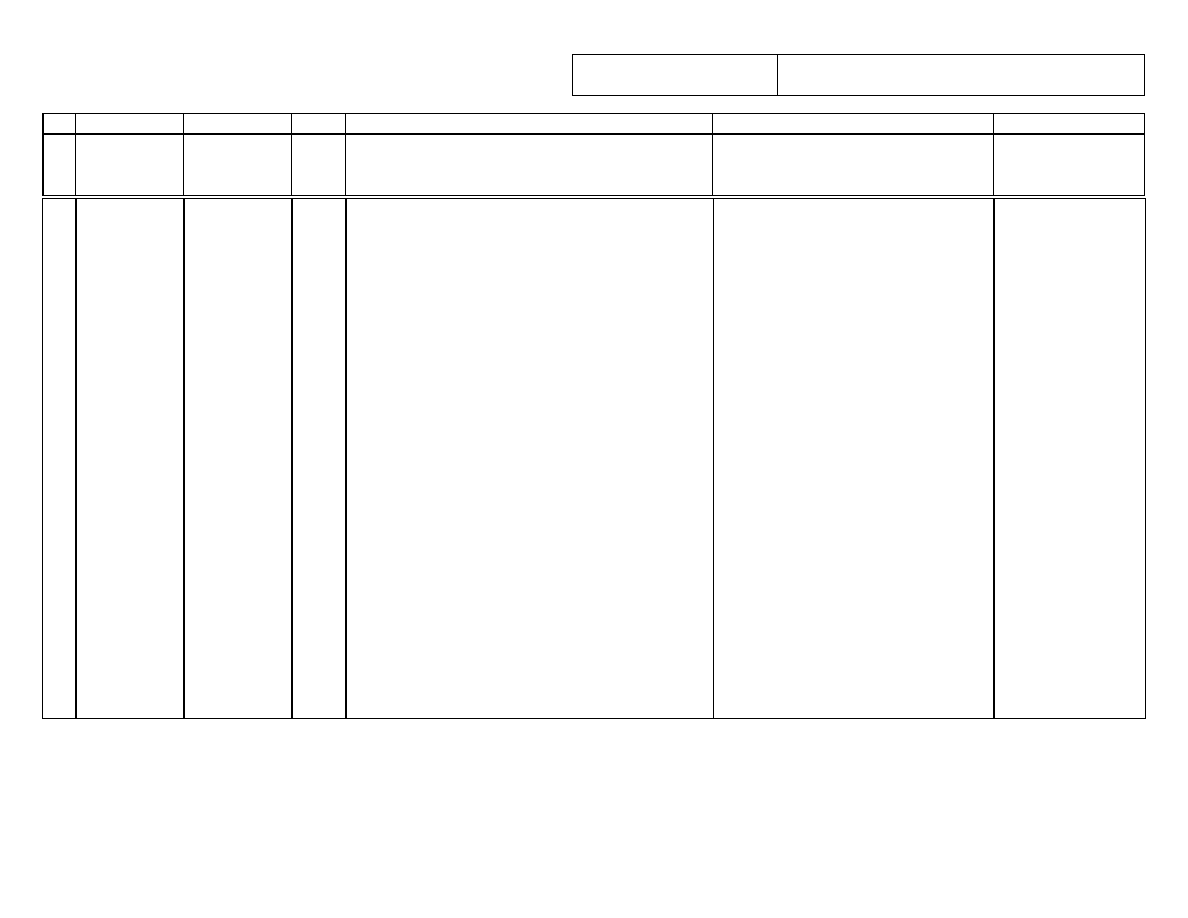
GB
DA
3.5.5.2
te
This example is fundamentally flawed. You are essentially saying
"If the widest scratch permitted on a surface is 15 microns then
the widest scratch permitted on the surface is 10 microns."
If the user really can allow 15 micron wide
scratches but not 20 micron wide scratches,
perhaps that should be stated explicitly on the
drawing without reference to this standard.
An alternate example might be "If the widest
permissible scratch is a Class C, a 15 micron
wide scratch is considered a Class C." However
an example is unnecessary, the meaning of the
ranges in the table is clear.
The very concept of
binning, which has been
used for 60 years, forces
the designer and the
inspector to over-
estimate the gravity of
features that fall into the
lower portions of a bin. If
the only purpose of the
binning system is to
serve as a symbolic
reference to the
maximum boundary of
the bin, then I think the
entire concept of binning
is rather silly. Just dump
the bins and designate
the specific upper
boundary that concerns
the designer.
Examples are used to
highlight the obvious as
well as to explain the
subtle. Simple examples
demonstrate clearly how
the meaning of the text is
to be applied. The three
examples were
constructed to
demonstrate notation,
not to restate the
meaning of the table.
They were constructed to
highlight three broad
categories of
imperfections: large,
intermediate, and tiny.
Template for comments and project leader observations
Date: 7 May 2009
Document: Commentary on Comments received
about proposed changes for OP1.002
1
2
(3)
4
5
(6)
(7)
IN
1
Clause No./
Subclause No./
Annex
(e.g., 3.1)
Paragraph/
Figure/Table/
Note
(e.g., Table 1)
Type
of
comm
ent
2
Comment (justification of change) by the project participant
Proposed change by the project participant
Project leader
observations
on each comment
submitted
1
IN: Initials of the project participant
Page 3 of 4
2
Type of comment: ge = general
te = technical
ed = editorial
NOTE
Columns 1, 2, 4 and 5 are mandatory
OEOSC document comments template version 1.0
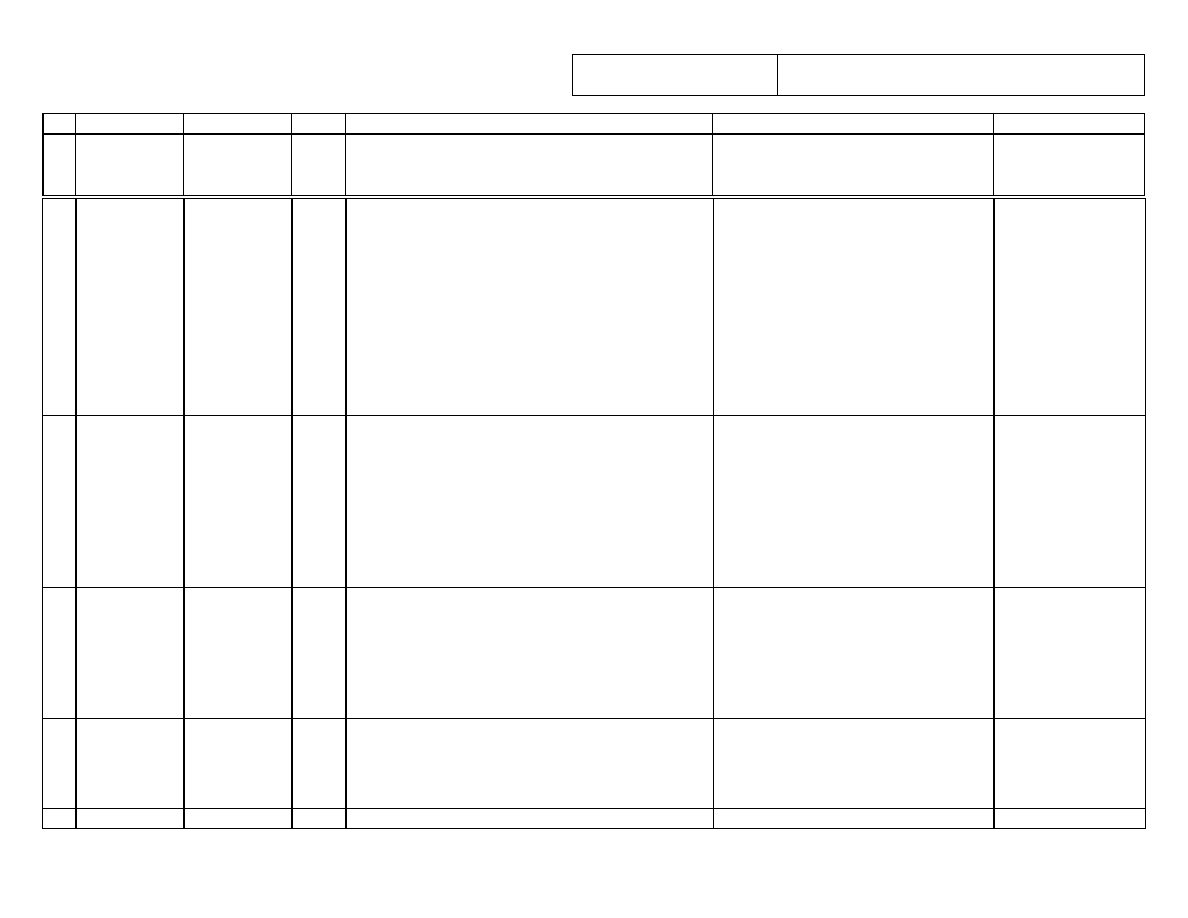
GB
3.6
ed
"When imperfections appear that might trigger the rejection"
seems awkward. "Controlled imperfections" sounds like
"deliberately applied imperfections."
Change to "Imperfections larger than the
"disregard" size must be evaluated in terms of
quantity and length. This section defines how
imperfections are to be accumulated during
inspection."
If I am to "disregard" an
imperfection, why am I to
include it during
accumulation? Sounds
like contradictory
language.
"Control" is somewhat
vague in a colloquial
sense; however, it is
commonly used in QA
and QC to reference
items of concern (See,
for example, the
language used to explain
GD&T).
GB
3.6.1
te
It is not clear that S is the
maximum allowed
class.
It also seems the rest of the wording of the existing 3.6.1 is being
reworded just for the sake of rewording it. It is no clearer than it
was, it is less clear.
"...the combined length of the scratches falling
within the maximum allowable scratch Class S
shall not exceed...Where: N is the number of
scratches in maximum allowable scratch Class
S...."
If a surface is designated
C-D, are we not
supposed to accumulate
the scratches in both
Class B and C? In other
words, don't we
accumulate in the
maximum allowed class
AND in one class below?
The change in language
was intended to resolve
this ambiguity.
GB
3.6.1, 3.6.2
te
Apparently "designated scratch" is being used instead of and to
mean "maximum allowable scratch." We haven't explained this
anywhere.
Go back to the commonly used and understood
term "maximum allowable scratch," or "maximum
allowable scratch class."
"Indicated scratch" might
be better than
"designated scratch".
The change in language
in these sections is an
attempt to link with the
language used in the
earlier sections of the
document.
DA
3.6.2
equations
te
The revised equations are ambiguous.
Change the summation from i=1 to n, where n is
the number of scratches to be considered for
accumulation.
Terms MAX and MIN
originally intended to
reference the maximum
and minimum scratch
classes need for the
calculation.
TT
3.6.2
equations
te
S
max
needs to be defined.
YES
Template for comments and project leader observations
Date: 7 May 2009
Document: Commentary on Comments received
about proposed changes for OP1.002
1
2
(3)
4
5
(6)
(7)
IN
1
Clause No./
Subclause No./
Annex
(e.g., 3.1)
Paragraph/
Figure/Table/
Note
(e.g., Table 1)
Type
of
comm
ent
2
Comment (justification of change) by the project participant
Proposed change by the project participant
Project leader
observations
on each comment
submitted
1
IN: Initials of the project participant
Page 4 of 4
2
Type of comment: ge = general
te = technical
ed = editorial
NOTE
Columns 1, 2, 4 and 5 are mandatory
OEOSC document comments template version 1.0
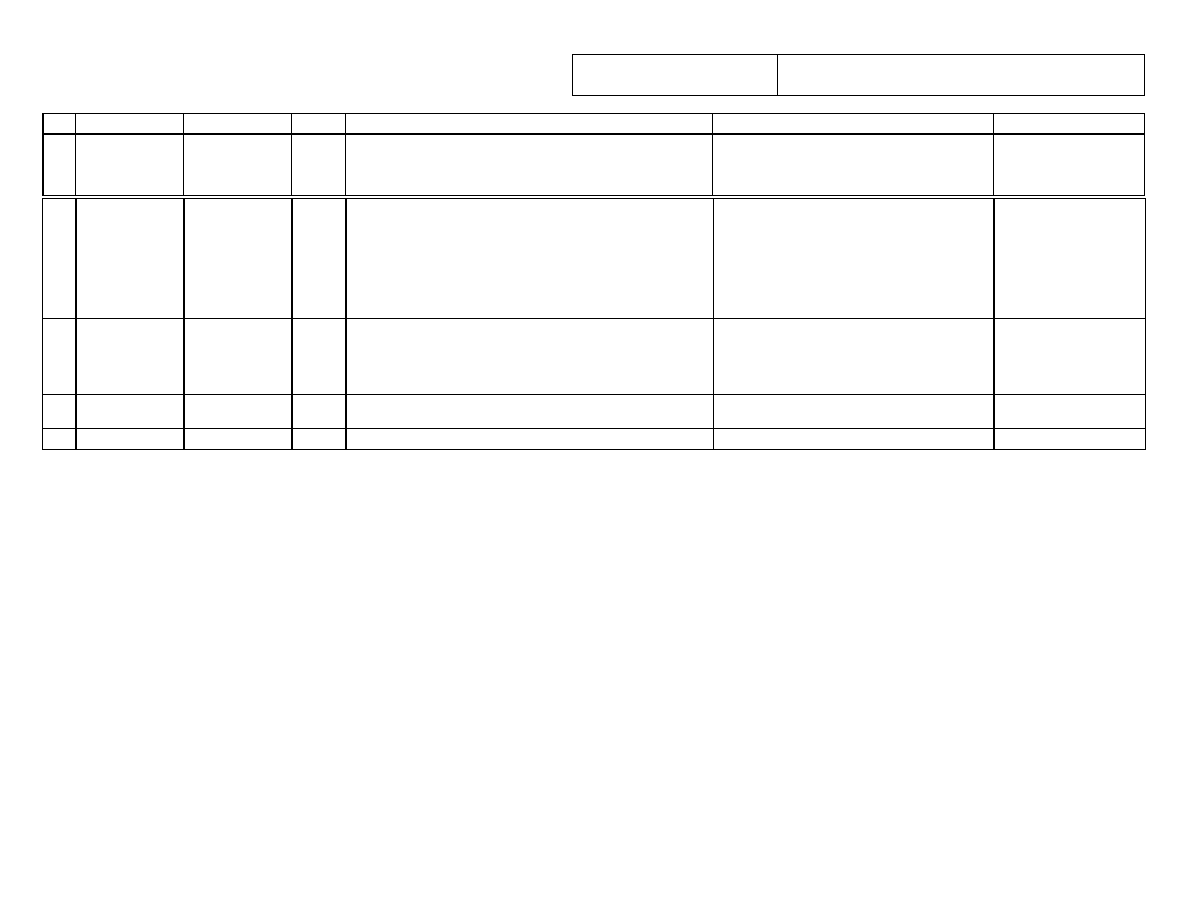
GB
3.6.2
equations
te
The alternate equations do perhaps make it a little easier to
understand, in that the units on both side of the inequality are
length (inches, mm, etc.). In the original equations the units on
both side of the inequality
may be
width (microns) or may they
may be
dimensionless (scratch # visibility).
The equations should only be offered as an alternate, not a
replacement. There is too much history, prior learning and training
material surrounding them to delete them
Offer the equations as alternate ways to express
the same requirements, or delete them for having
marginal value.
It is indeed a problem
when a traditional
explanation, or in this
case, a traditional
equation, is murky.
GB
3.7.2.4 (new)
If microscope inspection and evaluation of scratches and digs is
being performed, buyer and seller should be allowed to agree to
use the actual measured dimension of each imperfection in doing
the accumulations rather than binning them into classes per
Table 1 and Table 2.
To be supplied.
YES
DA
(new)
The standard does not address sleeks: what they are and how to
deal with them. We should provide direction.
YES