Draft
Minutes
ASC OP1
Optics and Electro-Optical Instruments – Optical Elements and
Assemblies –
Wavefront Standard
Monday August 27, 2007, 8:30 a.m. – 12:00 noon
Auditor’s Summary of Meeting
At this meeting the task force
concentrated upon the statistical evaluation of wavefront
measurement. After a presentation about the practical application of
power spectral density measurement, D. Aikens presented an edited
version of ISO 10110-8 for the Task Force to review as a basis for a
new OP1.004 draft document. The document was examined section by
section. In the area of surface roughness, much time was devoted to
a discussion concerning the designation of power spectral density
(PSD)
on optical drawings. At the conclusion, it was agreed that there
would not be a default specification for PSD,
but there would be for rms
roughness.
Items that needed definition or
description were assigned to various participants, and an interim
conference call was planned to report progress before the next
meeting in January 2008.
Welcome and Introductions
S. Martinek agreed to act as
leader of the meeting, and opened the meeting at 8:41a.m. with a
round of introductions.
Adoption of
Agenda
D. Aikens moved to adopt the
agenda. M. Dowell seconded the motion, which carried unanimously.
Approval of draft minutes
of the May 14, 2007 meeting
C. Evans suggested that the term
PVr
be defined in the minutes because there is no other document that
defines it. The secretary asked C. Evans to e-mail the definition to
him so that it can be added to the minutes.
PVr has been proposed as a robust PV –
which aims to be insensitive to differences in camera pixel
resolution and does not require arbitrary removal of "fliers"
or spikes.
Definition:
PVr = PV(36 term Zernike fit) + N x
rms(Zernike residual)
PVr is the sum of the PV of a 36 term
Zernike fit (after removing those terms set to zero (eg piston and
tilt for flats) and N times the rms of the residual after fitting to,
and removing, 36 terms. The default value of N is 3.
PVr
adds a representation of mid-spatial frequency to show that the term
is robust for surfaces that follow the
 type
of behavior. It is useful for specifying optics for trade. D.
Aikens added that the traditional peak-valley
measure has become somewhat obsolete because of modern detector
technology. Without specifying some kind of filtering, peak-valley
cannot be used. One way to circumvent the problem is to do a Zernike
fit to the detector data. The problem of applying Zernikes to the
data is that the fitting process does not take into account all of
the other Zernike terms that have not been used in the fit. So C.
Evans has developed an algorithm that is fairly robust, in that it
reports the same value for similarly behaving surfaces. It achieves
the spirit of the peak-valley
concept, whereby a single number is reported for the surface. The
number is different than the corresponding rms
value, but it has value, and is much better than the traditional
peak-valley
reading. V. Yashchuk asked why peak-valley
was being specified rather than rms.
S. Martinek replied that this provides a link to those in the
industry who evaluate surfaces by eye.
type
of behavior. It is useful for specifying optics for trade. D.
Aikens added that the traditional peak-valley
measure has become somewhat obsolete because of modern detector
technology. Without specifying some kind of filtering, peak-valley
cannot be used. One way to circumvent the problem is to do a Zernike
fit to the detector data. The problem of applying Zernikes to the
data is that the fitting process does not take into account all of
the other Zernike terms that have not been used in the fit. So C.
Evans has developed an algorithm that is fairly robust, in that it
reports the same value for similarly behaving surfaces. It achieves
the spirit of the peak-valley
concept, whereby a single number is reported for the surface. The
number is different than the corresponding rms
value, but it has value, and is much better than the traditional
peak-valley
reading. V. Yashchuk asked why peak-valley
was being specified rather than rms.
S. Martinek replied that this provides a link to those in the
industry who evaluate surfaces by eye.
D. Aikens moved that the minutes
be approved with the addition of the definition of PVr.
R. Williamson seconded the motion, which carried unanimously. C.
Evans was invited to present a review of PVr
at the next meeting.
Practical
application of power spectrum
J. Harvey showed an example
where he was using the surface power spectral density function as a
specification for a mirror that was being purchased. Conventionally,
figure and finish, or micro-roughness, are specified, such as, figure
to be better than 0.1λ and
<20 Ǻ rms
roughness. The surface power-spectral-density function is
essentially a plot of surface variance as a function of spatial
frequency. This makes possible the specification of surface
irregularity over the entire range of relevant spatial frequencies.
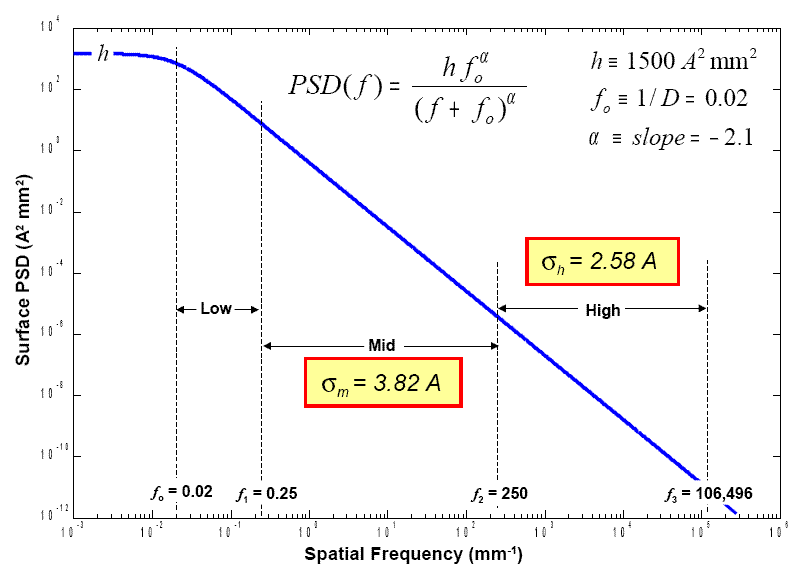
He
showed graphs to illustrate an example. The low end of the
spatial-frequency domain covers figure errors that produce
conventional aberrations, and the high end of the spatial-frequency
domain covers micro-roughness that produces the wide-angle scatter
that reduces contrast in an image. What has historically not been
specified, or measured, is the mid-spatial-frequency surface errors
that fall between the conventional figure errors and micro-roughness.
When the surface PSD
is specified, then the whole range is covered. This technique has
been applied to components for a UV telescope. The equation for the
PSD
is
 .
The resulting curve, which is a radial profile of a 2D PSD,
would be the ceiling for acceptance of measured data. Practically,
the measured data may wander around the specification curve, and if
appropriate, small deviations above the curve in limited areas would
be acceptable.
.
The resulting curve, which is a radial profile of a 2D PSD,
would be the ceiling for acceptance of measured data. Practically,
the measured data may wander around the specification curve, and if
appropriate, small deviations above the curve in limited areas would
be acceptable.
J. Harvey showed graphs
comparing predicted and measured BRDF
data for a Molybdenum mirror. He stated that they can now use fitted
PSD
data from measured scatter data to predict the PSD
at other wavelengths or angles of incidence.
Fabricators are now being
introduced to this method of specification, although there is
resistance to using it; however, in time it will become accepted.
Following this presentation, the
Task Force took a five minute break.
Wavefront
Standards
OP1.004
D.
Aikens started by saying that P. Takacs had earlier put together a
scope statement that lists changes to existing ISO documents required
to make a statistically based wavefront standard. D. Aikens took that
scope document and used it to review ISO 10110-8. He drafted another
document to describe what would need to be changed in order to meet
the Takacs scope. D. Aikens presented this latter document at the
Paris ISO/TC 172/SC 1 meeting in June. The ISO Working Group
accepted the input. There is now a new project to re-author ISO
10110-8 with the US leading the effort.
D.
Aikens reminded the group that ISO 10110-8 is only a notation
standard; therefore it should not define technical terms. However,
in cases where there is no definition elsewhere, terms are defined in
it. It will not address measurement.
At
this point the the draft was projected for the group to review. The
document was also available on the OEOSC web site.
The
first change occurred in section 3.5 where new terms were introduced.
M. Dowell asked if the terms should be in alphabetical order. D.
Aikens said that the existing definitions appeared to be grouped
according to the area in the standard that they were being used. If
necessary, they can be reordered later. S. Martinek asked if the
terms listed in color were terms that D. Aikens had added. D. Aikens
confirmed that they were.
C.
Evans said that he had been looking in ISO/DIS 25178-2, “Geometrical
product specifications (GPS) –
Surface texture: Areal –
Part 2: Terms, definitions and surface texture parameters.” He
said that many of the terms that D. Aikens has added are included
there. D. Aikens said that the Task Force has two choices:
Make
ISO/DIS 25178-2 a normative reference, which means that users would
have to buy that standard;
Redefine
the terms in the current document making sure that the definitions
are consistent with ISO/DIS 25178-2.
P.
Takacs said that the second approach was preferable, but he concurred
that it is imperative that the current document be consistent with
the GPS document. He said that these terms are similar to those used
in ASME standards. C. Evans said that the ASME standard is B46.1 –
2002 Surface Texture (Surface Roughness, Waviness, and Lay).
D.
Aikens asked if C. Evans would be willing to reconcile the
definitions with what is in existing documents. C. Evans agreed to
assist in the reconciliation. P. Takacs said that he would help
also. D. Aikens said that he would get a copy of ISO/DIS 25178-2,
but asked that someone else take the lead in defining the terms
because all he has done is identify most of the terms without actual
definitions.
D.
Aikens said that section 3.10, Average Slope (Sa), needs to be
reconciled with not only existing standards, but also the revision of
ISO 10110-12. This document has descriptions newly developed. He
asked what the Task Force needs to do with respect to “sampling
length,” “low-pass cutoff,” “resolution”
and “high-pass cutoff.” Have these terms been related in
another document? P. Takacs did not know of another document that
addressed the relationships. C. Evans said that B46 has default
cutoffs. P. Takacs replied that he thought that the B46 cutoffs were
left over from the days of analog filtering. The Task Force needs to
understand how they would adapt that language for the current
standard. C. Evans said that these would be defaults, and the user
could have the option of choosing other filters. D. Aikens said that
he favored defaults.
The
ISO 10110 documents make no distinction between “sampling
length” and “long spatial-frequency cutoff.” There
is no distinction between “spatial resolution” and “high
spatial-frequency cutoff.” There are factors of 2 that need to
be considered in several areas. S. Martinek added a caution about
sampling lengths because these are holdovers from stylus measurement
days. Making the document consistent with stylus techniques will add
a degree of complexity that he feels should not be undertaken.
It
was noted that Micro-defects was defined both in section 3.4 and
3.14. D. Aikens said that 3.4 was not a good definition. P. Takacs
said that the purpose was to make the imperfection an out-lier. M.
Dowell thought that the definition should be made relevant to the
wavelength of the illumination used, because a micro-defect in the UV
would not be an issue in the IR. S. Martinek proposed that it be
defined as a fraction of a wavelength. D. Aikens said that in the
original draft “micro-defects” were a replacement for a
roughness specification. P. Takacs said that surface roughness is
independent of wavelength, so the document would have to separate the
wavelength of use from roughness. The Task Force agreed to add it to
the list of items that need to be addressed.
D.
Aikens noted that section 4, Surface Texture, makes use of
profilometery terminology. He suggested that instrument developers
look at this text to see if the standard is unintentionally biased
toward profilers. Areal measurement terminology may need to be
factored into the text. He noted that the industry is increasingly
using areal profilers as well as stylus profilers.
D.
Aikens added two notes to section 4.1 to address cautions that P.
Takacs had included in his scope document.
At
this point M. Dowell recommended that the Task Force keep track of
the items that need to be addressed.
In
section 4.2 D. Aikens noted that the original document had to be
changed to require the specification of a lower sampling length and
spatial resolution because he did not understand how rms
would have any meaning without spatial frequency sampling. He also
added a default specification that the surface roughness of a matte
surface will be assumed to be over a sampling length of 300
μm
with a spatial resolution of 2 μm.
He said that the Task Force must decide if those numbers are
reasonable defaults. S. Martinek asked if there is a threshold value
for Rq
since the surface is assumed to be matte. D. Aikens replied that the
use of Rq
appears later in the document.
D.
Aikens suggested that the same concept be applied to polished
surfaces.
In
section 4.3 covering polished surfaces, D. Aikens added a fourth
measurement method, “rms
slope” to describe a specular surface. It is
based upon material contained in ISO 10110-12. He presumed that it
should be moved from part 12 to part 8 since it did not belong in an
aspheric specification.
D.
Aikens asked if anyone was familiar with the DIN method of grading
micro-defects , which appears later in the document. M. Dowell asked
why the user would care about micro-defects. D. Aikens replied that
it appears to be a workmanship issue. P. Takacs said that it looked
like a scratch and dig type of specification. D. Aikens continued
that he could not see how to use the information in a statistical
analysis. M. Dowell suggested that the draft could state that the
user is interested in the rms
value and the distribution of these imperfections. Then the user
could decide whether to include this micro-defect specification. P.
Takacs said that when the user is making a profile measurement on the
surface of interest, these isolated imperfections need to be avoided
so that the underlying surface roughness can be determined. Isolated
micro-defects raise the high-frequency end of the rms
curve because they cause a lot of scatter. The micro-defects may be
noted in a final inspection to indicate their existence.
M.
Dowell noted that the scratch and dig specification was being pushed
into the sub-micron regime; what is done there needs to be consistent
with what is done here.
D.
Aikens concluded that this section is not used in the US, but
probably is in Europe. So, this section cannot be removed. M.
Dowell asked if anyone had seen this used by a customer. D. Aikens
replied that he had, but that he was not confident that the customer
knew how to use micro-defects properly.
V.
Yashchuk said that there are two problems in this area. One is
determining the number and distribution of these micro-defects over
the surface, and the second is what is the profile of an average
defect. In terms of frequency, these are two different things.
D.
Aikens continued the examination of micro-defects in section 4.3
where they are quantified using PN. PN ranges are listed in Table
A.1 in Annex A. He noted that one of the lens design programs
defaults to this PN notation when it generates its drawings.
Section
4.3.3 covers PSD.
The current text defines PSD
in an unusual manner:
 .
The A coefficient has units
of μ3-B.
J. Harvey has defined
PSD
as
.
The A coefficient has units
of μ3-B.
J. Harvey has defined
PSD
as
 ,
where the alphas
cancel, and the h
coefficient can be specified in the desired units.
,
where the alphas
cancel, and the h
coefficient can be specified in the desired units.
J.
Harvey said that he now prefers the K-correlation representation of
the PSD:
 .
D. Aikens said that there would be a problem with units for the a
and
b coefficients for the K-correlation. M. Dowell said that the units
do not need to be defined; the PSD
would be given its normal units after the calculation was completed.
P. Takacs agreed. D. Aikens accepted that suggestion, but countered
that the Task Force does need to decide the units for PSD.
L. Assoufid said that he did not like hybrid units, and D. Aikens
said that he loved them because the units that result in the simplest
form of A
(without many zeros) is nm2mm.
These units result in A
having a value of 1. P. Takacs inferred that those units mean 1 nm
roughness and 1 mm spatial frequency. D. Aikens continued that the
hybrid unit emphasizes that there are two spatial parameters in the
vertical axis and one spatial parameter in the horizontal axis. P.
Takacs agreed that it is a compelling argument. M. Dowell reminded
the Task Force that ISO standards use SI units; V. Yashchuk
concurred. D. Aikens countered that if that is required, then the
unit would be 10 raised to the gazillionth power. The current unit
is μ3,
which is usable, except that frequency has to be written in μ.
P. Takacs asked if the units had to be specified. D. Aikens said
that when the notation is written with a number, the unit has to be
known.
.
D. Aikens said that there would be a problem with units for the a
and
b coefficients for the K-correlation. M. Dowell said that the units
do not need to be defined; the PSD
would be given its normal units after the calculation was completed.
P. Takacs agreed. D. Aikens accepted that suggestion, but countered
that the Task Force does need to decide the units for PSD.
L. Assoufid said that he did not like hybrid units, and D. Aikens
said that he loved them because the units that result in the simplest
form of A
(without many zeros) is nm2mm.
These units result in A
having a value of 1. P. Takacs inferred that those units mean 1 nm
roughness and 1 mm spatial frequency. D. Aikens continued that the
hybrid unit emphasizes that there are two spatial parameters in the
vertical axis and one spatial parameter in the horizontal axis. P.
Takacs agreed that it is a compelling argument. M. Dowell reminded
the Task Force that ISO standards use SI units; V. Yashchuk
concurred. D. Aikens countered that if that is required, then the
unit would be 10 raised to the gazillionth power. The current unit
is μ3,
which is usable, except that frequency has to be written in μ.
P. Takacs asked if the units had to be specified. D. Aikens said
that when the notation is written with a number, the unit has to be
known.
J. Harvey noted that one-sided or
two-sided PSD
cases must be considered.
M. Dowell asked if the user was
required to specify the transfer function of the measurement
instrument. D. Aikens said that he put a caution in the text. M.
Dowell urged that the specification be required because the customer
and supplier could get two different results. D. Aikens said that he
was not sure how to put that into a notation. V. Yashchuk said that
notation does not need to identify calibration; there is a
measurement standard that would cover instrument calibration.
D. Aikens then reviewed his
section 4.3.4 covering “surface
slope.” He used what had been accomplished in
Paris for ISO 10110-12. He asked if there were a better definition.
P. Takacs said that for the past twenty years his organization has
sampled the surface with their sampling length whose high frequency
limit is about 1 mm. So they get a series of points with 1 mm
separation. They calculate the spectral density to get the slope
power spectrum. All the information needed is in that slope power
spectral density. They then integrate the slope measurement
point-by-point to get a height distribution. The height PSD
can be calculated by two different methods. One is to start with the
slope PSD
and do a Fourier inversion; the other is to do a Fourier transform on
the integrated height data.
L. Endelman said that he did not
understand what D. Aikens meant by “focusability.” M.
Dowell suggested that it be changed to “the ability to come to
focus.” J. Harvey said that when an image is fuzzy, the
uninitiated assume that it is out of focus, no matter what the cause.
He suggested that the text should concentrate on “image
quality.”
S. Martinek said that there could
be a potential notation conflict with section 4.3.4 RMS Surface Slope
(Sq).
ISO has defined Sq
as an areal rms
notation.
D.
Aikens then reviewed section 5, Indication in Drawings. He suggested
changes to the notation for PSD.
The current indication is
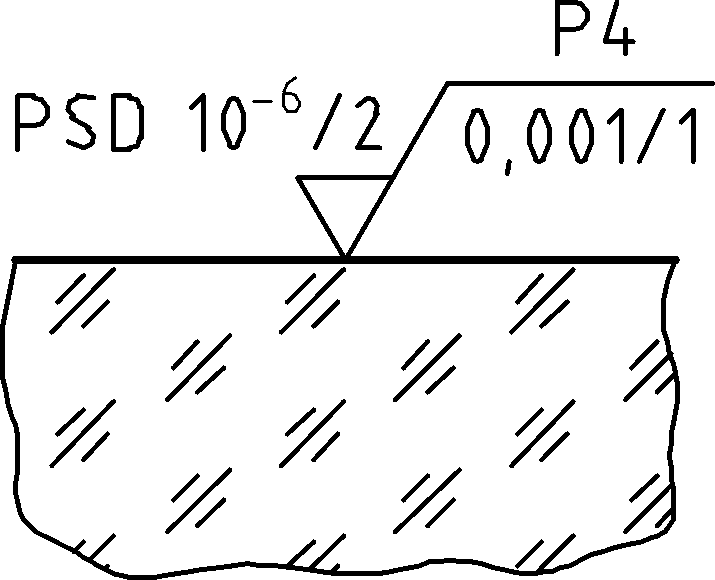 .
The notation really needs to include a,
b, and c
coefficients. At a minimum a
and b are needed —
a coefficient for the power spectrum and then a fractal coefficient.
P. Takacs suggested that if the K-Correlation function would be
used, then additional slashes would be required after the PSD
notation to make room for them. He said that the c
parameter indicates the location of the “knee” on the PSD
curve. The K-Correlation function is good because it has a finite
rms
roughness from
0 –
∞. The fractal
form has an infinite rms
roughness. The
a, b,
c form can also turn
into a fractal function under specific circumstances.
.
The notation really needs to include a,
b, and c
coefficients. At a minimum a
and b are needed —
a coefficient for the power spectrum and then a fractal coefficient.
P. Takacs suggested that if the K-Correlation function would be
used, then additional slashes would be required after the PSD
notation to make room for them. He said that the c
parameter indicates the location of the “knee” on the PSD
curve. The K-Correlation function is good because it has a finite
rms
roughness from
0 –
∞. The fractal
form has an infinite rms
roughness. The
a, b,
c form can also turn
into a fractal function under specific circumstances.
D.
Aikens wondered how far from the industry norm this area should be
allowed to go. Perhaps a different PSD
should be defined, such as PSDK,
to permit a different formula for the reporting the power spectrum.
P. Takacs suggested that if more numbers were listed after the PSD
notation on the indication, then the user would know which form was
incorporated.
W.
McKinney noted that the majority of PSD
curves reported in literature that exhibit the “knee”
characteristic are the result of instrumental artifacts. When the
three coefficients are added to the indication specified by the
standard, then the user may get the impression that the “knees”
are a part of the PSD
rather than the result of the measurement. If the standard
recognizes the “knee” then users may infer that the data
in literature showing the knee must be correct.
D.
Aikens urged that the straight line portion of the curve is of
interest for polished surfaces. The fractal characteristic of the
polishing process results in a straight line. P. Takacs agreed with
that conclusion for fractal polishing techniques; however, there are
cases when the polishing process is not fractal in nature, and some
processes can produce plateaus. To illustrate his point, P. Takacs
said that a ground surface has a white-noise characteristic. After
polishing begins the higher frequencies show attenuation. The rough
terrain still shows up in the lower frequencies, but the high
frequencies have begun to roll off. That is not a fractal
characteristic; rather the PSD
looks like the K-Correlation. As polishing continues the
high-frequency data levels because its characteristic is limited by
the size of the polishing compound. As polishing continues the PSD
curve moves toward the left. There is a range of shapes that can be
imposed by polishing. J. Harvey added that the K-Correlation does
include the fractal condition as a special case.
D.
Aikens concluded that the average user will have difficulty
understanding any of this. A. Krisiloff reminded the Task Force that
the problem is to create a notation that adequately describes what
the measurement is to produce. V. Yashchuk pointed out that spatial
filtering needs to be considered to take into account the finite
pixel size of the detector used to capture the surface data. D.
Aikens said that these items would appear in the measurement section
(standard for ISO), which still has to be written. M. Dowell asked
if the PSD
characteristic could be described in the measurement section. D.
Aikens replied that what is being proposed is that a user needs to be
able to describe a shape, not just a line, for the PSD,
and the notation must allow for that. He suggested that the easiest
way to accomplish that is to have notations for two different types
of PSD.
There will probably be four versions altogether:
1D
PSD,
2D
PSD,
1D
PSDK,
2D
PSDK.
D.
Aikens said that the standard needs default specifications. P.
Takacs said that a default would change depending upon the
application because different ranges would come into play. D. Aikens
replied that the default would be for a typical surface if no scan
lengths were specified. P. Takacs continued saying that the default
in that case would be the measuring instrument; unfortunately, there
is not typical measuring instrument. The measuring instrument for
surface roughness traditionally would be a New View or a BAF –
an interference microscope with a 10
objective. S. Martinek said that these instruments are not a
default. D. Aikens clarified his assertion that there needs to be a
default by saying that the notation should provide a statement
telling the optics maker what the lack of a specification means. P.
Takacs countered that the notation requires the specification writer
to declare a band width.
A.
Krisiloff said that he agreed with D. Aikens desire for default
specifications, because a standard is better when it offers default
conditions. If the standard does not provide for defaults, then
there can be instances when a court room would have to decide what
the defaults would be.
P.
Takacs continued saying that when the user puts the
symbol on the drawing, the absence of the bandwidth indication under
the check mark raises a flag to the manufacturer. D. Aikens reminded
the Task Force that the PSD indication will appear on a small
percentage of drawings. In the majority of drawings
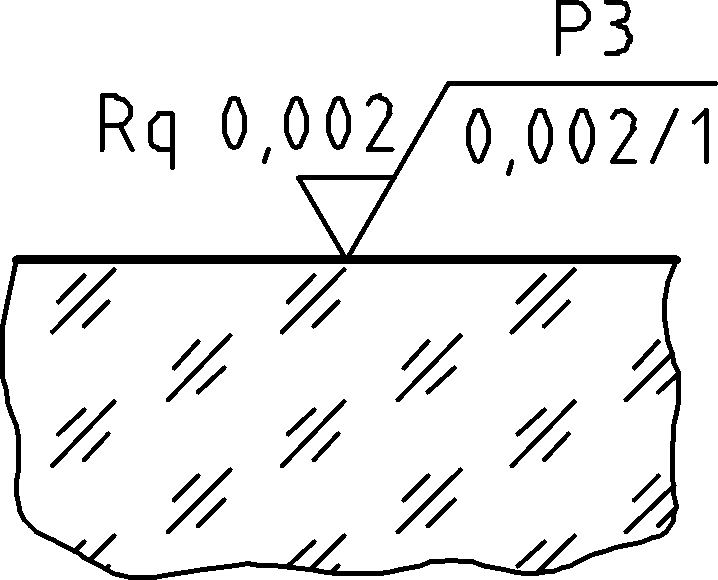 is the symbol that will be used, and a lot of engineers write Rq
and a value, but they do not include the
bandwidth, even though they should. D. Aikens wants the standard to
provide a default bandwidth for the manufacturer to use if the
engineer forgot to include it. He agreed with P. Takacs in that
there should not be a default for PSD.
is the symbol that will be used, and a lot of engineers write Rq
and a value, but they do not include the
bandwidth, even though they should. D. Aikens wants the standard to
provide a default bandwidth for the manufacturer to use if the
engineer forgot to include it. He agreed with P. Takacs in that
there should not be a default for PSD.
Tasks
to be Completed
At
this point S. Martinek asked the Task Force to return to the list of
tasks that need to be completed, so that volunteers could be
recruited.
Address
micro-defects (defined both in 3.4 and 3.14) —
S. Martinek suggested that this topic be deemphasized.
Expanded
2D PSD
definitions —
P.
Takacs, L. Assoufid, V.
Yashchuk, W. McKinney
D.
Aikens volunteered to write discussion about rms,
rms
slope,PSD
in the foreword.
Slope
—
P. Takacs,
L. Assoufid, V. Yashchuk, W. McKinney
Structure
measurement
Bandwidth
limits —
D. Aikens, S. Martinek
S.
Martinek called for the first draft of the revision for the January
meeting. D. Aikens proposed a conference call on November 15, 1:00
pm EST to review interim progress.
The
Task Force agreed to add a peak to valley discussion to the January
agenda. A review of the OP1.004 draft would also be included.
L. Endelman complemented the
Task Force saying that he had seen more progress at this meeting then
he had seen in the previous two years. He could almost see the
glimmer of a CD coming out.
OP1.005
Not
addressed.
Time and Place for next
OP1 Wavefront Meeting
D. Aikens moved that the group
meet next in San Jose, CA on Sunday, January 20, 2008, 2:00 p.m. –
5:00 p.m.. M. Dowell seconded the motion. The motion carried
unanimously.
Adjournment
D.
Aikens moved that the meeting be adjourned. L. Endelman seconded the
motion. The meeting was adjourned at 12:03 p.m.
11/02/07
11:56:58 AM ASC OP1 Wavefront Draft Minutes, 8-27-07.odt