Approved
Minutes
ASC OP1 ASC OP/SC 1, BSR/OEOSC-OP1.002, Optics and
Electro-Optical Instruments – Optical Elements and
Assemblies — Appearance Imperfections Task Force Draft
Standard Review
Sunday, January 25, 2004
8:30 a.m. — 4:30 p.m.
Fairmont Hotel, Sacramento Room
San Jose, CA
At this meeting the committee reviewed comments received on the written ballots for the approval of this draft as a standard. Section 3.4, “Scratches (Long Imperfections)” was modified to add a section describing scratch visibility vs. scratch number. Several other minor adjustments were made. An observer had stated that the reference standards were not described properly. The committee agreed that the source of the drawings for the reference standard should be found and added to the standard. When the secretary completes these edits, he is instructed to submit the draft to ANSI for final approval.
A progress report was presented concerning how successful were trained observers in consistently identifying imperfections.
The scope of the follow-on performance specification was discussed and tasks to prepare for the next meeting were assigned.
J. Hamilton opened the meeting at 8:33 a.m. Since there were several new participants each person was asked to introduce him or her self.
D. Aikens moved that the second revision of the draft agenda be adopted. H. Johnson seconded the motion. The motion carried unanimously.
The minutes had been distributed by e-mail. G. Boultbee moved that the draft minutes be approved. W. Royall seconded the motion, which carried unanimously.
The committee made one final pass through the draft standard to examine it along with the comments submitted with the ballots that were issued on December 29, 2003.
Section 2.1.6: The comment received with a ballot stated, “Consider rewording to say ‘A marking or tearing of the optical surface that usually has v-groove contour that is longer in dimension than it is wide.’” J. Tejada asked if the definition of “scratch” in section 2.1.6 includes variations in diamond turning character around the surface? D. Aiken thought that diamond turned characteristics are more of a surface texture condition. G. Boultbee moved that the revised wording in version 7 be accepted. The motion carried unanimously.
Section 3.2.1: The committee agreed with the deletion of “If not specified on drawings, the default tolerance for scratches and digs shall be 80 50.”
Section 3.4.2: A ballot comment was, “We have referenced the government scratch and dig drawing in this document, but we have been silent (as has 13830) as to how to handle the scratch number in an accumulation situation. Is a scratch which is more visible than a 60 but less visible than an 80 considered to be an 80, or can it be a 70 or a 75 or…? J. Hamilton stated that Northrop Grumman states the number step-wise. W. Royall said that Kodak formerly stated the scratch stepwise, but now the inspectors are making a judgement if imperfection is between the stepwise numbers. For the sake of making this draft standard a drop in for 13830, the committee should leave it the rating stepwise. G. Boultbee suggested that the committee should continue with the review and return to this section after other comments are handled.
Section 3.4.3: The ballot comment was, “What was the rationale for limiting this section to #10 and #20 scratches? Does this mean that if the tolerance is a #120 scratch, a cluster of #60 scratches is acceptable? J. Hamilton noted that this section comes directly from 13830; it should be kept to be consistent. The committee agreed.
Section 3.5.1: The ballot comment was, “Suggest replacing ‘rounding up’ with ‘but shall be at least one’.” After some discussion the committee agreed to leave it “rounding up”.
Section 3.6.1.5: The ballot comment was, “Suggest relocating this to become 3.6.2.2 and renumbering 3.6.1.6 and 3.6.1.7 accordingly. The committee concurred with this suggestion.
3.6.2: The ballot comment was, “Suggest 3.6.2 simply be the title ‘Fractures’ and the sentence currently in 3.6 be separated as 3.6.1. The words ‘this paragraph’ currently in 3.6.1.5 be replaced by ‘3.6.1’.” The committee agreed to this change.
Comment from an Observer: “Only the Foreword mentions 13830 reference. Para. 3.2.1.3, 3.9, 3.9.2.3, refer to comparison standards without any description, source of supply (Bryson Optics never responded to my inquiry) – so any reference in this OP1.002 is highly informal and meaningless!” The committee noted that the current military drawing does reference Bryson as supplier, so referencing Bryson would be redundant. ASC OP has no control over the military comparison standards drawings. The committee asked the secretary to find the contact address where the drawings can be obtained. The address will be added as a footnote. D. Aiken moved that the committee override the “no” vote that accompanied these observer comments. W. Royall seconded the motion. The motion was unanimously approved.
The committee recessed at 9:55 a.m. and reconvened at 10:27 a.m.
The first task following the recess was to revisit 3.4.2 A decision must be made whether one rounds up or down when grading a part. A manufacturer would want to round down, whereas a buyer would want to round up. The point of this section is to handle accumulations of scratches. G. Boultbee proposed that the following wording be made section 3.4.1 under the title of “Scratch Visibility vs. Scratch Number”: “When the visibility of scratch i is between the visibility of two artifacts on the Comparison Standard referred to in 3.2.1, its scratch number, si, shall be that of the higher scratch number on the Comparison Standard.” The other sections in 3.4 would be renumbered to accommodate this insertion. In section 3.9 remove “Surface Quality Comparison Standard (hereinafter called the”. D. Aikens moved that accept G. Boultbee’s wording. R. Oleneck seconded the motion, which passed unanimously. The committee agreed to add “(hereinafter referred to as the Comparison Standard)” to section 3.2.1.
This completed the final review of the draft standard. When the address where the military drawings can be ordered is added to the draft, it will then be ready for submitting to ANSI for final approval.
J. Hamilton reported that his organization looked at the ability of inspectors to perceive and assess the scratches from Bryson samples and Kodak paddles. He took five standard Bryson pieces and cut them in half and used a new letter designation to identify the pieces. He then set up a randomized experiment to evaluate the scratch against the standard as seen by the operator. All operators’ eyesight has been evaluated. The inspection station has been moved to a room that has no ambient light except some coming through the doorway. Preliminary assessment: valid results were achieved only 50% of the time. Inspection method 1 described in the draft standard gives slightly better results. Perhaps the human eye cannot deal properly with mono width samples. He stated that the project should be completed within one month.
The committee recessed at 11:50 am. for lunch and reconvened at 1:21 p.m.
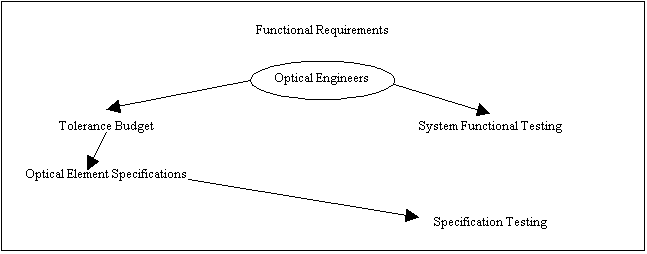
D. Aikens asked if everyone had a chance to review John Greivenkamp’s presentation of “Functional Test or Standards for Cosmetic Defects.” J. Greivenkamp has created a correlation diagram to relate imperfections to various parameters of the optical system. R. Olenick suggested that the optical engineer should list the imperfection and the factor affected by the imperfection on the drawing. D. Aikens said that a good optical engineer knows how much amplitude and phase error can be permitted.
R. Olenick suggested that the performance standard should cover aspects of the optical manufacturing process that affect the final performance. One can measure global affects, how can one address local imperfections unambiguously. He asked if it is possible to separate the cosmetic imperfections from others. D. Aikens went through the Greivenkamp list identifying those items that would fall into a functional local surface imperfection arena: scratches, digs, pinholes/spatter, dirt (could be treated as a defect), bubbles, stain, tooling marks. There are two possible classes of standards: local area and large area (covered by phase). Chips and fractures should be added because, in addition to traditional concerns, they also affect sealing a system if the chip or fracture allows leakage.
W. Royall thought that the group would find a series of tests for different imperfections with a corresponding group of standards. They may be included in a single standard, or grouped into a series of standards. Defining the scope of this project is not going to be easy to determine. D. Aikens suggested that the list of “defects” could be grouped to arrive at the class of specifications. Narrow-angle scatter and wide-angle scatter may be the broad groupings. W. Royall wondered if scatter would capture a situation – for example, obstructions on the rear element that is very close to the image surface.
R. Olenick noted that from comments made during this meeting, cost of the specification method seems to be important. D. Aikens stated that standards should capture best practices, or suggest potential best practices. In the latter case, the proposed best practice should be economical in order to be accepted by the optics community. H. Pollicove has continually reminded the committee that there are many “mom and pop” businesses that cannot afford expensive test procedures.
|
|
Objective Measurement |
Subjective Measurement |
|
Performance Standard |
MTF |
Picture Quality |
|
Not Performance Standard |
Dig Standard |
Scratch Standard |
L. Endelman asked why we couldn’t now create the scope of the standard. It is straightforward to move from the lower right-hand corner of the above chart to the lower left-hand corner. However, what is needed to get to the upper left-hand corner is not apparent. Perhaps upper left should now include wavefront. Since the chart was drawn, scratches and digs have now moved to the performance row.
L. Endelman offered a straw scope:
This standard is for determining the performance of optical components and elements individually and not as assemblies. The criteria for acceptance of optical performance is based on the following assumptions:
Imperfections may impact performance.
Create a measurement standard that will be industry friendly and not financially impact the small companies.
Standard is to facilitate trade.
Optical Designers will provide insight into equipment, techniques and methods to make comparison measurements.
Stimulate Trade by offering manufacturers and users an accurate means of specifying components and being able to price accordingly.
Provide better interchangeability for repair and replacement of assemblies.
Determine possible degradation of optical systems due to use and age.
Possible alternate use of optics in new applications
D. Aikens proposed the next steps.
Poll constituents for functional requirements that are impacted by scratch and dig or other imperfections (Everyone)
Schedule or plan for an objective scratch measurement method (D. Aikens and J. Hamilton)
Notation
Measuring techniques and tools
Finish the gauge study (J. Hamilton)
Plan to sell/manufacture/specify a comparator (H. Johnson)
Investigate other technologies for determining equivalent imperfections (e.g., auto industry), (ASME)
The committee decided to defer to the Board for selecting the next meeting date and location.
W. Royall moved that the meeting be adjourned. W. Czajkowski seconded the motion. The meeting was adjourned at 4:10 p.m.